Barnham Coats of Arms
Over a period of several centuries, the Crown granted patents of
nobility to four members of the Barnham family. Burke, Extinct and Dormant
Peerages of Great Britain, states that all of them have subsequently lapsed
in default of male heirs. The oldest of these, mentioned in Fairbairn’s
Crests of the Leading Families in Great Britain and Ireland, and their Kindred
in other Lands, was bestowed upon Sir Walter Barnham by Richard II (reigned
1377-1399). Sir Walter was born about 1350, during the reign of Edward III
(reigned 1327-1377) and was Chancellor of the Exchequer during the reign
of King Richard. The exact date of his elevation to the nobility is not known.
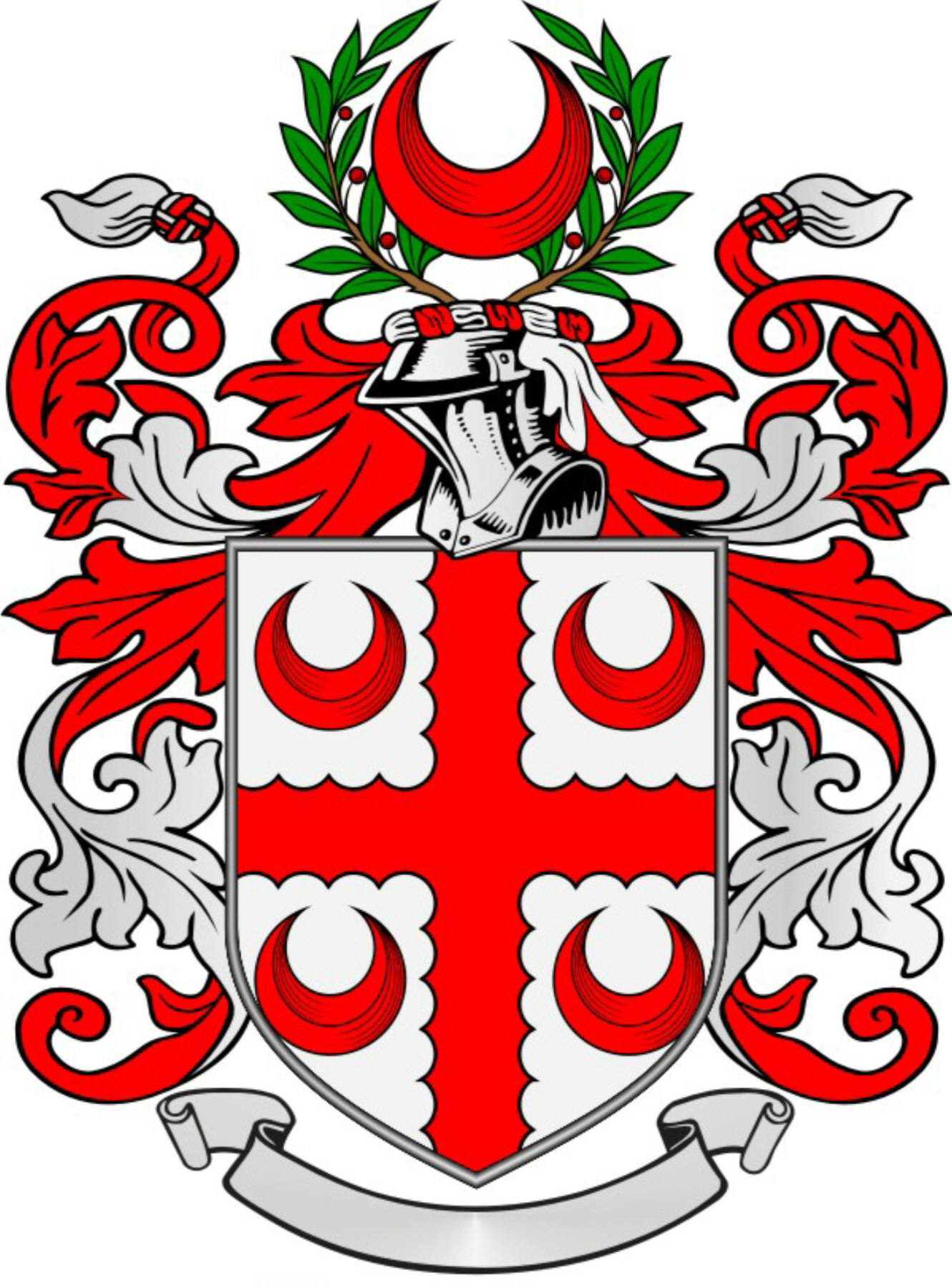
Sir Walter’s arms are illustrated below in accordance
with the description mentioned.
|
These arms
were granted at an unknown date to Sir Walter Barnham, L.C.B. (fl. 1350) and
were blazoned: Argent, a cross gules between four crescents gules. Crest: A
crescent gules between two laurel branches in orle proper. It is not known
whether a motto accompanied this blazoning of arms.
|
The second patent of nobility granted to a member of the Barnham
family was bestowed upon an unknown member of the family, possibly the father
of Sir Nicholas Barnham. Sir Nicholas and his father were both killed 22 August
1485 in Leicestershire, England, along with Richard III at the Battle of
Bosworth Field.

|
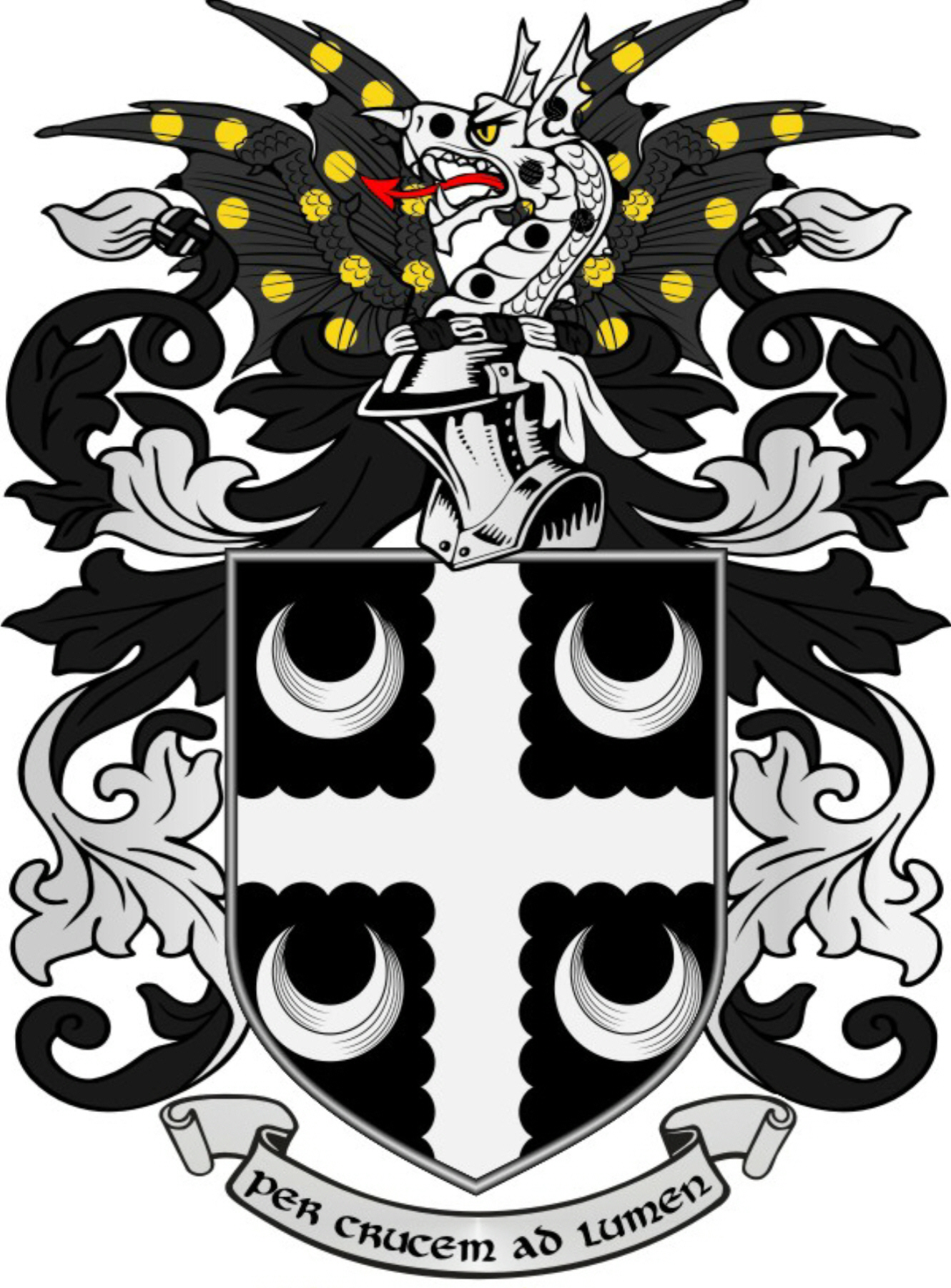
Above are
the arms granted to an unknown descendant of Sir Walter Barnham. These arms
are blazoned: sable, a cross engrailed between four crescents argent. Crest: A
dragon's head argent pelletée between four dragon's wings sable bezantée.
Motto: Per Crucem ad Lumen — “Through the Cross to the Light.”
|
The third patent of nobility that is known to have been granted by
the Crown to a member of the Barnham family is that of Sir Martin Barnham,
Knight of Hollingbourne, who was Sheriff of Kent in 1598. Sir Martin was
knighted on July 23, 1603, by James I (reigned 1603-1625). This was just a few
months after James had ascended the throne following the death of Elizabeth I (reigned
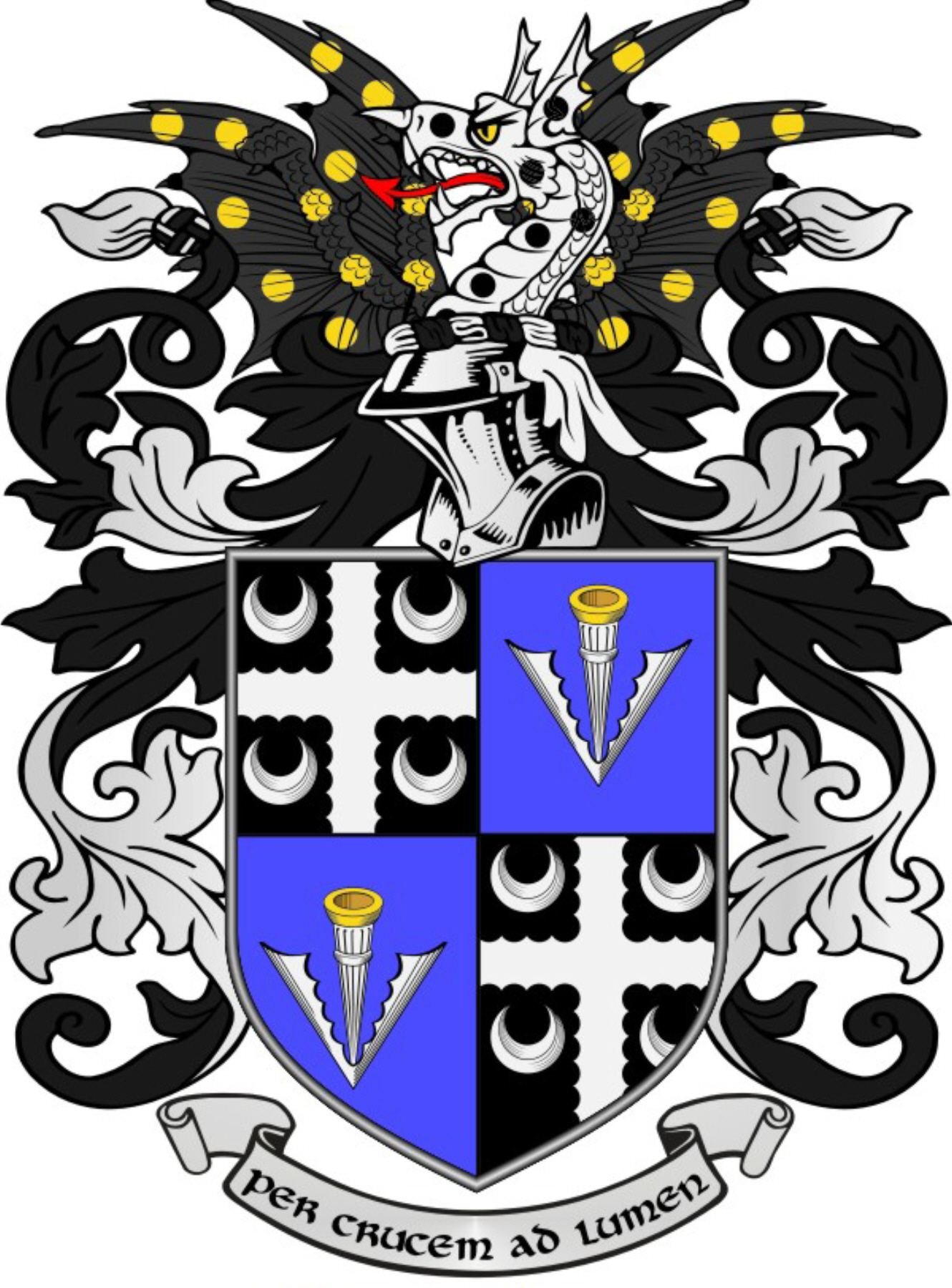
1558-1603). Note the quartering of the Barnham arms with those of Martin's
mother, the heiress Alice Brodbridge. The use of the phaeon (the heraldic broad
arrow) is an example of canting or punning arms — using a broad arrow
for the sound of Brodbridge.
|
Above are
the arms of Sir Martin Barnham, kt., which quarter the arms of his father
(Barnham) and mother (Brodbridge). These arms are blazoned: quarterly 1st
and 4th sable, a cross engrailed between four crescents argent;
2nd and 3rd azure, a phaeon proper. Crest: A dragon's head argent
pelletée between four dragon's wings sable bezantée. Motto: Per Crucem ad
Lumen — “Through the Cross to the Light.”
|
Sir Robert Barnham, esquire, was created a baronet on August 15, 1663
by Charles II (reigned 1660-1685). His was the fourth patent of nobility
granted to a member of the Barnham family. According to Burke's Heraldry,
“[T]he heiress of Sir Robert Barnham, second and last baronet, married Thomas
Rider, esquire. A branch of the Barnhams still exists at Norwich.” No example
has been found of the arms of Robert Barnham, bart., but it may reasonably be
assumed that they were similar to those of his grandfather, Sir Martin Barnham.
The principal difference would likely have been the quartering of the Barnham
arms with those of Robert's mother, the heiress Elizabeth Lennard, as
illustrated below.
|
The arms of Robert
Barnham, bart. quarter the arms of his father (Barnham) and mother (Lennard).
These arms are blazoned: quarterly 1st and 4th sable, a
cross engrailed between four crescents argent; 2nd and 3rd or, on
a fess gules three fleur-de-lis of the first. Crest: A dragon's head argent
pelletée between four dragon's wings sable bezantée. Motto: Per Crucem ad
Lumen —“Through the Cross to the Light.”
|
| HOME | EMAIL | SURNAMES |
A
Research Guide to the Genealogy of the Barnum/Barnam/Barnham Family Worldwide
The information on this site is developed and maintained by Patrick
Barnum
©1998, 2022. The format of this website and all original statements
and narrative included on it are copyrighted and all rights are reserved.
Factual information may be freely quoted for use in private genealogical
research when accompanied by a full source citation, including the date of
acquisition. Click here to view the format of a citation for
an Internet resource. The publication of large extracts from this site in any form
requires prior written consent.
BACKTO TOP