The arrival of the immigrant ancestor Thomas BARNUM (or BARNHAM, or BARNAM) in the British Colonies of North America is well documented. A number of sources also refer to his probable English roots, although without offering documentation. Even without a documented connection, however, information concerning the English forebears of the Barnum family will be of interest to many. So, I've included on this website a partial genealogy of the Barnham family in England, together with a mention of a few isolated individuals of the same or similar surname. For those who may be interested, I've also included in this section a narrative version of the family history of the first Barnum generation in North America, as well as a similar narrative concerning the life of the famous showman Phineas Taylor "P.T." BARNUM.
In New England Families, Cutter says an investigation of the
English ancestry of the Barnum family of America justifies the belief that the
immigrant ancestor was a son or grandson of Sir Martin and Judith (Calthorpe)
BARNHAM. His mother or grandmother was the daughter of Sir Martin CALTHORPE, lord
mayor of London, and Sir Francis BARNHAM, knight of Hollingbourne, was either
stepbrother or uncle, and the wife of Francis BACON (Lord Bacon), great lord
chancellor and viscount, was either first or second cousin. Noah Greeley
Barnum, in The Barnum Family, 1350-1907, states (without providing
documentation) that this same immigrant ancestor was the 15th child
of Sir Francis BARNHAM and his wife Lady Elizabeth LEONARD. The Encyclopaedia
Britannica, 15th edition, confirms that
In spite of that singular uniformity of descent in North America, the same can't be said of the European record. As a result of the many linguistic changes that have affected the English language over more than 950 years since the first recorded appearance of the surname Barnham, numerous other spellings have been encountered in the genealogical and historical record. References have been found to (among others) Simon DE BERNHAM (1273), Willelmus BARNOM (1379) and Stephen BARNEHAM (1592). Frank Holmes, in the Directory of the Ancestral Heads of New England Families, calls the name a corruption of Bearnham, meaning a town in a wood or on a hill, and notes that the original family seat was at Southwick, Hants, England. Bardsley, in his Dictionary of English and Welsh Surnames, defines it as a location-derived surname meaning of Barnham, and referring to parishes in Ely, Chichester, and Norwich. Whatever the truth may be, the current English spelling of Barnham first appears in historical documents dating from the mid-14th century.
This web site includes references to the earliest-known members of the family, both in England and in North America, together with annotated family trees for all those Barnum families that have a historically documented relationship. The family name has appeared at various times and in various countries as Barnham, Barnam, Barnom, De Bernham, Bearnham, Barneham, and Barnum (and perhaps other spellings). Often, different sources show two or more spellings of the surname for the same individual. In fact, the immigrant ancestor appears to have been born with the surname Barnham, and to have used both Barnam and Barnum after arriving in the British Colonies of North America. In the genealogy presented on this site, I've generally followed the convention of using Barnham for the English branch and Barnum for the descendants of the immigrant ancestor. With a few exceptions, that convention follows actual usage by the individuals involved. However, the spellings Barnam, Barnham and Barnum all appear on this site and searches for specific individuals should be undertaken with that in mind. Although the complete record of the family of Thomas BARNUM appears within the body of this site, some may be interested in reading a history of the first North American generation in narrative form. The following few paragraphs of narrative are included for them.
The First Barnum Generation in North America
Thomas BARNUM (or BARNHAM, or BARNAM) is said to have been born about 1625, probably in County Kent, England. He died on 26 Dec 1695 in Danbury, Connecticut. As mentioned above, Noah G. Barnum, in The Barnum Family, 1517-1904 states (without providing documentation) that Thomas BARNUM was the 15th child of Sir Francis BARNHAM and his wife Lady Elizabeth LEONARD (LENNARD). He also states that Thomas left England in 1640 to come to the American Colonies, where he first settled in what is now Bethel, Fairfield County, Connecticut.
This is perhaps a good place to insert a CAUTIONARY NOTE about Noah G. Barnum's unproven statements concerning the parentage of Thomas Barnum, and about a few other doubtful entries you may find in our Barnum family history. There is no documentary evidence of the true parentage of Thomas Barnum, and without that evidence, the reference to Sir Francis Barnham, as his father, is really nothing more than a supposition. Detailed research by the College of Arms in London, England, suggests that Thomas was almost certainly not a son of Sir Francis. It was quite common during the early 1900s for families to write or commission genealogical records for the express purpose of showing their descent from the earliest settlers of North America - or from the European nobility. The result was a fair amount of questionable research - and even the publication of some outright falsehoods. As a result, while both the direct descendants of Thomas Barnum and the English line of Barnham are shown on this site, the connection between them should be considered probable, but not certain, because of the lack of reliable documentary evidence. The users of this site are also cautioned to keep in mind that the original data upon which much of this genealogy was based may be suspect in some respects. One of the unfortunate aspects of using any written genealogy (including this one) is that there is a tendency to accept what is written as fact, even though the original source may be suspect.
As an example, literally hundreds of entries in both written and internet genealogies show the immigrant ancestor Thomas Barnum as Thomas (Earl) Barnum or as Thomas Earl Barnum, and have him married to Mary Feaks or Feakes. In fact, documentation exists for a marriage (in England) between a Thomas BARNEHAM and a Mary FEAKS (or FEAKES). However, the birth and death dates for that Thomas Barneham are very different from those for Thomas Barnum, the immigrant ancestor. During more than 60 years of research into Barnum family genealogy, no documentation has been found to justify associating the name or title of Earl with Thomas Barnum, and it is quite clear that he was never married to Mary Feakes or Feaks. Yet, that erroneous data continues to be cited by careless researchers. This problem appears to have originated with an error posted by a member of the LDS Church in 1942, citing a source that does not mention either Mary Feaks or the name or title Earl. It has been compounded over the years by having been accepted by hundreds of persons who have neither researched nor questioned it.
Additionally, there are many places where the name of Thomas Barnum's first wife is cited as Hannah HURD. This is another apparent error that has been compounded over the years by its acceptance without question or research. All available sources indicate that, while her name was probably Hannah, her surname was almost certainly not Hurd. This error probably arose from confusion with the second wife of Thomas, who, before she married Thomas Barnum, was Sarah (Thompson) HURD, the widow of John Hurd, Sr. of Stratford, who died in 1681.
Although I sincerely hope that this web site will be a useful tool for genealogical research, and that it will provide hours of enjoyment to new generations of Barnum family genealogists, I suggest that it be used primarily as a guide to further research. There is no substitute for primary documentation in the study of genealogy.
Now, let's return to the story of our ancestor Thomas BARNUM. According to Orcutt's History of Stratford, Thomas came first to New York and afterward to Norwalk. Several sources agree that he married (1st) a wife whose name may have been Hannah, but whose surname is not known, and had with her all of his ten children. He purchased land in Fairfield, Connecticut on 28 Feb 1673, and received a grant of land in Norwalk five years later. The grant reads: Granted by the plantation unto Thos: Barnam a certaine swampe lyinge neere the west side of Stonie brooke and not far of Soabatucke hill, the sayed swampe containinge five acres more or lesse and lyeth bounded of west north and south with the common land. Aprill the 30th, 1678. That same year, he sold his land in Fairfield and removed to Norwalk. Hall's History of Norwalk says: Thomas Barnam, of Fairfield, had a grant before 1663. The same history gives the assessment of his estate in lands in that town in 1671 and 1687 as 40 pounds. There is also a mention of Thomas in a Fairfield book of records as follows: 28 Feb. 1673 Thomas Barnam has by purchase of John Crump one parcel of land at Maximus, being in quantity by estimation three quarters of an acre more or less. The next record is in Norwalk, dated 30 Apr 1678, and says that the plantation granted to Thomas Barnam was three acres lying by the land said Thomas purchased of John Rayment. At a town meeting in Norwalk, on 8 Nov 1681, he was appointed to oversee and keep good Decorum amongst the youth in times of exercise on the Sabbath and other Publique meetings; and the town doe impower him if he see any disorderly, for the keep of a small stick to correct such with; onely he is desired to doe it with clemency; and if any are incoridgable in such disorder, he is to present them either to their parents or masters; and if they doe not reclaime them, then to present such to authority. Cutter, in New England Families, Notes that Thomas Barnam was one of the first eight settlers of the town of Danbury, Connecticut, in 1684. The History of Stratford makes the same statement. The others are listed as: Thomas TAYLOR, Francis BUSHNELL, John HOYT, James BENEDICT, Samuel BENEDICT, James BEEBE and Judah GREGORY. Those eight individuals purchased from the local Indians a large tract of land that now includes the towns of Danbury, Bethel, New Fairfield, Redding, Ridgefield, and a portion of Derby, and established there the settlement of Danbury. Thomas located his homestead in a portion of the new settlement that in 1855 became a part of the town of Bethel, and is known today as the Old Homestead at Grassy Plain. He was charged by his fellow settlers with the formulation of the articles of agreement establishing the form of civil government that they were to have in their new town. From that, and other references found in contemporary records of the locality, it appears that Thomas BARNUM was a man of more than ordinary intelligence among the immigrants of his time, and was very active in both church and town affairs. He married (1st), in 1660, Hannah, whose maiden surname is not known. She died in 1683. The Barnum Family, 1350-1907 calls her Hannah HURD (providing no source for that name) and also calls her the mother of the first four children of Thomas. All other available sources indicate that her surname is not known, and also state that she was the mother of all ten of the known children of Thomas. Thomas and Hannah had the following children:
|
+ |
i. |
Thomas BARNUM, Jr. |
Born 9 Jul 1663 in Norwalk, Connecticut; died 17 December 1730 in Danbury, Connecticut. |
|
+ |
ii. |
Sarah BARNUM |
Born 1665 in Norwalk, Connecticut; died 1744 in that same place. |
|
+ |
iii. |
Esther BARNUM |
Born 1667 in Norwalk, Connecticut. |
|
+ |
iv. |
Abigail BARNUM |
Born 1669 in Danbury, Connecticut. |
|
+ |
v. |
Francis BARNUM |
Born 1671 in Norwalk, Connecticut; died 20 May 1736 in Danbury, Connecticut. |
|
+ |
vi. |
Deacon Richard BARNUM |
Born 1675 in Norwalk, Connecticut; died after 14 January 1739. |
|
+ |
vii. |
John BARNUM |
Born 24 February 1677 in Norwalk, Connecticut. |
|
|
viii. |
Hannah BARNUM |
Born 4 October 1680 in Norwalk, Connecticut; died after 1708. |
|
+ |
ix. |
Ebenezer BARNUM |
Born 29 May 1682 in Norwalk, Connecticut; died 17 September 1755 in Kent, Connecticut. |
|
|
x. |
Ruth BARNUM |
Born about 1684 in (probably) Danbury, Connecticut. She was the first white female child born in Danbury. |
Thomas married (2nd) Sarah (Thompson) HURD. The most likely date for their marriage is after 1684 (the birth year of Thomas' daughter Ruth), since most sources agree that all of his children were born of his first marriage. Although some sources do suggest that Thomas had only four children with his first wife, the dates make that impossible. At least eight of the children of Thomas were born while his second wife, Sarah (Thompson) HURD, was still married to her first husband. Sarah THOMPSON was born in 1642 in Stratford, Connecticut, and died on 24 Jan 1718 in that same place. Her father was John THOMPSON (b. about 1617), the first of that name in Stratford. Prior to her marriage to Thomas BARNUM, she had been married to John HURD, Senior, of Stratford, who died in 1681. Thomas died on 26 Dec 1695, aged about 70 years. His estate, which amounted to 330 pounds, 4 shillings, 4 pence, was divided among five sons and five daughters, the eldest son to have a double portion. His widow, Sarah, returned to Stratfield in Stratford, and died there in Jan 1718 at the age of 76 years.
The Life of Phineas Taylor (P. T.) Barnum
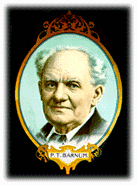
Phineas Taylor BARNUM was born 5 Jul 1810 in Bethel, Connecticut and died 7 Apr 1891 in Bridgeport, Connecticut. He became a celebrated American showman by employing sensational forms of presentation and publicity to popularize such amusements as the public museum, the musical concert, and the three-ring circus. In partnership with James A. BAILEY, he made the American circus a popular and gigantic spectacle, the so-called Greatest Show on Earth .
At the peak of his career,
Barnum's own appearance was nearly as familiar to the public as the exhibits he
promoted. An impressive figure, six feet two inches tall, semi-bald, with blue
eyes, a bulbous nose, and a potbelly, he called himself the Prince of Humbugs.
He dwelt in a three-story Oriental mansion, named Iranistan, on a 17-acre
estate in Bridgeport, Connecticut, where he played host to such notables as
George CUSTER, Mark TWAIN, Horace GREELEY, and Matthew ARNOLD. Close friends
regarded him as good-natured, thoughtful, and kind, as well as parsimonious and
egotistical. The quote 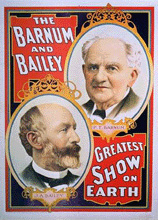 There's a sucker born every
minute is often attributed to him. Barnum himself doubted ever having uttered
those words, although he conceded that he might have said, "The people like to
be humbugged". In the appendix to A. H. Saxon, P. T. Barnum: The Legend and
the Man (1989), it's claimed that the phrase "There's a sucker born every
minute, but none of them ever die" actually originated with a notorious con man
known as Paper Collar Joe (real name, Joseph BESSIMER), and was later falsely
ascribed to Barnum by show-business rival Adam FOREPAUGH in a newspaper
interview. Barnum never took specific pains to deny it, and even thanked
Forepaugh for the free publicity. In spite of the confusion about the statement
mentioned above, Barnum was fond of making extravagant and colorful statements,
many of which have been properly quoted. Among them is the paraphrased
statement, Every crowd has a silver lining. He served two terms in the
Connecticut legislature (1865-67) and a term as mayor of Bridgeport (1875).
Barnum was nominated by the Republican Party as a candidate for U.S. Congress
(1867), but was defeated. His Democratic opponent was William Henry BARNUM
(1818-1889), a third cousin once removed, who, as a U.S. Senator, became known
for doing much to help re-elect Grover Cleveland as President.
There's a sucker born every
minute is often attributed to him. Barnum himself doubted ever having uttered
those words, although he conceded that he might have said, "The people like to
be humbugged". In the appendix to A. H. Saxon, P. T. Barnum: The Legend and
the Man (1989), it's claimed that the phrase "There's a sucker born every
minute, but none of them ever die" actually originated with a notorious con man
known as Paper Collar Joe (real name, Joseph BESSIMER), and was later falsely
ascribed to Barnum by show-business rival Adam FOREPAUGH in a newspaper
interview. Barnum never took specific pains to deny it, and even thanked
Forepaugh for the free publicity. In spite of the confusion about the statement
mentioned above, Barnum was fond of making extravagant and colorful statements,
many of which have been properly quoted. Among them is the paraphrased
statement, Every crowd has a silver lining. He served two terms in the
Connecticut legislature (1865-67) and a term as mayor of Bridgeport (1875).
Barnum was nominated by the Republican Party as a candidate for U.S. Congress
(1867), but was defeated. His Democratic opponent was William Henry BARNUM
(1818-1889), a third cousin once removed, who, as a U.S. Senator, became known
for doing much to help re-elect Grover Cleveland as President.
What is now New York's famous Madison Square Garden opened in April 1874 under the name Barnum's Hippodrome. At the north end of the city's 38-year-old Madison Square Park, on Fifth Avenue was a shed that had been used until 1871 as a freight depot for the New York and Harlem Railroad. Barnum spent $35,000 to remodel the roofless structure and sold his lease that winter to Patrick S. GILMORE for a handsome profit. Gilmore renamed it Gilmore's Garden and used it for flower shows, policemen's balls, America's first beauty contest, religious and temperance meetings, and the first Westminster Kennel Club Show, while Barnum pitched his circus tent at Gilmore's Garden each spring. Madison Square Garden got its present name on May 30, 1879 when it was acquired and renamed by the railroad heir William K. VANDERBILT, who announced that it would be used primarily as an athletic center.
BARNUM himself eloquently described the sort of life lived by him and his contemporaries in Bethel, in the first years of the 19th century. In his 71st year, he presented a bronze fountain to the citizens of his birthplace, accompanying the presentation with the following speech.
My friends: Among all the varied scenes of an active and eventful life, crowded with strange incidents of struggle and excitement, of joy and sorrow, taking me often through foreign lands and bringing me face to face with the King in his palace, and the peasant in his turf-covered hut, I have invariably cherished with most affectionate remembrance the place of my birth, the old village meeting house, without steeple or bell, where in its square family pew I sweltered in summer and shivered through my Sunday-school lessons in winter, and the old school-house where the ferule, the birchen rod, and rattan did active duty, and of which I deserved and received a liberal share. I am surprised to find that I can distinctly remember events that occurred before I was four years old.
I can see as if but yesterday our hard-working mothers hetcheling their flax, carding their tow and wool, spinning, reeling, and weaving it into fabrics for bedding and clothing for all the family of both sexes. The same good mothers did the knitting, darning, mending, washing, ironing, cooking, soap and candle making, picked the geese, milked the cows, made butter and cheese, and did many other things for the support of the family.
We babies of 1810, when at home, were dressed in tow frocks, and the garments of our elders were not much superior, except on Sunday, when they wore their 'go-to-meeting clothes' of homespun and linsey-woolsey.
Rain water was caught and used for washing, while that for drinking and cooking was drawn from wells with their 'old oaken buckets' and long poles and well sweeps.
Fire was kept overnight by
banking up the brands in ashes in the fireplace, and if it went out one
neighbor would visit another about daylight the next morning with a pair of
tongs to 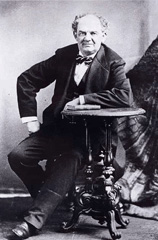 borrow a coal of fire to
kindle with. Our candles were tallow, home-made, with dark tow wicks. In summer,
nearly all retired at early dark without lighting a candle except on
extraordinary occasions. Home-made soft soap was used for washing hands, faces,
and everything else. The children in families of ordinary circumstances ate
their meals on trenchers, wooden plates. As I grew older, our family and others
got an extravagant streak, discarded the trenchers, and rose to the dignity of
pewter plates and leaden spoons. Tin peddlers who traveled through the country
with their wagons supplied these and other luxuries. Our food consisted chiefly
of boiled and baked beans, bean porridge, coarse rye bread, apple sauce, hasty
pudding beaten in milk, of which we all had plenty. The elder portion of the
family ate meat twice a day and had plenty of vegetables, fish of their own
catching, and occasionally big clams, which were cheap in those days, and shad
in their season. These were brought from Norwalk and Bridgeport by fish and
clam peddlers. Uncle Caleb Morgan, of Wolfpits or Puppytown, was our only
butcher. He peddled his meat through Bethel once a week. It consisted mostly of
veal, lamb, mutton, or fresh pork, seldom bringing more than one kind at a time.
Probably he did not have beef oftener than once a month. Many families kept
sheep, pigs and poultry, and one or more cows. They had plenty of plain
substantial food. Droves of hogs ran at large in the streets of Bethel.
borrow a coal of fire to
kindle with. Our candles were tallow, home-made, with dark tow wicks. In summer,
nearly all retired at early dark without lighting a candle except on
extraordinary occasions. Home-made soft soap was used for washing hands, faces,
and everything else. The children in families of ordinary circumstances ate
their meals on trenchers, wooden plates. As I grew older, our family and others
got an extravagant streak, discarded the trenchers, and rose to the dignity of
pewter plates and leaden spoons. Tin peddlers who traveled through the country
with their wagons supplied these and other luxuries. Our food consisted chiefly
of boiled and baked beans, bean porridge, coarse rye bread, apple sauce, hasty
pudding beaten in milk, of which we all had plenty. The elder portion of the
family ate meat twice a day and had plenty of vegetables, fish of their own
catching, and occasionally big clams, which were cheap in those days, and shad
in their season. These were brought from Norwalk and Bridgeport by fish and
clam peddlers. Uncle Caleb Morgan, of Wolfpits or Puppytown, was our only
butcher. He peddled his meat through Bethel once a week. It consisted mostly of
veal, lamb, mutton, or fresh pork, seldom bringing more than one kind at a time.
Probably he did not have beef oftener than once a month. Many families kept
sheep, pigs and poultry, and one or more cows. They had plenty of plain
substantial food. Droves of hogs ran at large in the streets of Bethel.
When one of the neighbors wanted to feed his hogs, he went out in the street and called 'Pig,' which was pretty sure to bring all the other hogs in the neighborhood. I remember one man, called 'Old Chambers,' who had no trouble in this respect, and he was the only one excepted from it. He had a peculiar way of getting his hogs from the general drove. When he wanted them, he would go out into the street and shout Hoot! Hoot! Hoot! At this cry, all the hogs but his own would run away, but they understood the cry and would stand still and take the meal.
Our dinners several times each week consisted of 'pot luck,' which was corned beef, salt pork, and vegetables, all boiled together in the same big iron pot hanging from the crane, which was supplied with iron hooks and trammels and swung in and out of the huge fireplace. In the same pot with the salt pork, potatoes, turnips, parsnips, beets, carrots, cabbage, and sometimes onions, was placed an Indian pudding, consisting of plain Indian meal mixed in water, pretty thick, salted, and poured into a home-made brown linen bag, which was tied at the top. When dinner was ready, the Indian pudding was first taken from the pot, slipped out of the bag, and eaten with molasses. Then followed the 'potluck.' I confess I like to this day the old-fashioned 'boiled dinner,' but doubt whether I should relish a sweetened dessert before my meat. Rows of sausages called 'links' hung in the garret, were dried, and lasted all winter.
I remember them well, and the treat it was when a boy, to have one of these links to take to school to eat. At noon, we children would gather about the great fireplace, and having cut a long stick, would push the sharpened end through the link, giving it a sort of cat-tail appearance. The link we would hold in the fire until it was cooked, and would then devour it with keen relish.
There were but few wagons and carriages in Bethel when I was a boy. Our grists of grain were taken to the mill in bags on horseback, and the women rode to church on Sundays and around the country on weekdays on horseback, usually on a cushion called a pillion fastened behind the saddle, the husband, father, brother, or lover riding in front on the saddle. The country doctor visited his patients on horseback, carrying his saddle-bags, containing calomel, jalap, Epsom salts, a lancet, and a turnkey, those being the principal aids in relieving the sick. Nearly every person sick or well was bled every spring.
Teeth were pulled with a turnkey, and a dreadful instrument it was in looks, and terrible in execution. I remember once having a convenient toothache. Like many other boys, I had occasions when school was distasteful to me, and the hunting for birch or berries, or going after fish, were more of a delight than the struggle after knowledge. This toothache struck in on a Monday morning in ample time to cover the school hour. I was in great pain and held onto my jaw with a severe grip. My mother's sympathetic nature permitted me to stay at home with the pain. My father was of rather sterner stuff. He didn't discover I was out of school until the second day. When he found out I had the toothache, he wanted to see the tooth. I pointed out one, and he examined it carefully. He said it was a perfectly sound tooth, but he didn't doubt but it pained very much, and it must be dreadful to bear, but he would have something done for it. He gave me a note to Dr. Tyle Taylor. Dr. Tyle read the note, looked at the tooth, and then, getting down the dreadful turnkey, growled, "Sit down there, and I'll have that tooth out of there, or I'll yank your young head off". I did not wait for the remedy, but left for home at the top of my speed, and I have not had the toothache since.
I remember seeing my father and our neighbors put through military drill every day by Captain Noah FERRY in 1814, for the war with Great Britain of 1812-15.
My uncles, aunts, and others, when I was a child, often spoke about the ravages of Indians from which their ancestors had suffered, and numbers of them remembered and described the burning of Danbury by the British in 1777.
One season, I attended the private school of Laurens P. Hickok (now Prof. Hickok), in which his sweetheart, Eliza Taylor, was also a scholar. One day, he threw a ruler at my head. I dodged, and it struck Eliza in the face. He quietly apologized and said she might apply that to some other time when she might deserve it. He and his wife are still living in Andover, Mass., a happy, grey-haired old couple of eighty or more.
Eliza's father, Esquire Tom TAYLOR sometimes wore white-topped boots. He was a large, majestic-looking man, of great will-force, and was considered the richest man in Bethel. Mr. Eli JUDD was marked second in point of wealth. Every year, I took twelve dollars to Esquire Tom TAYLOR to pay the interest on a two-hundred-dollar note which my father owed him. I also annually carried four dollars and fifty cents to Eli JUDD for interest on a seventy-five-dollar note which he held against my father. As these wealthy men quietly turned over each note filed away in a small package until they found the note of my father, and then indorsed the interest thereon, I trembled with awe to think I stood in the presence of such wonderfully rich men. It was estimated that the richer of them was actually worth three thousand dollars!
Esquire Tom TAYLOR made quite a revolution here by one act. He got two yards of figured carpet to put down in front of his bed in the winter, because the bare board floor was too cold for his feet, while he was dressing. This was a big event in the social life of that day, and Esquire Tom was thought to be putting on airs, which his great wealth alone permitted.
 When I was but ten years old,
newspapers came only once a week.
When I was but ten years old,
newspapers came only once a week.
The man who brought us the week's papers came up from Norwalk, and drove through this section with newspapers for subscribers and pins and needles for customers. He was called Uncle SILLIMAN. I can remember well his weekly visit through Bethel, and his queer cry. On coming to a house or village, he would shout, 'News! News! The Lord reigns!' One time, he passed our schoolhouse when a snowstorm was prevailing. He shouted: 'News! News! The Lord reigns and snows a little.'
It took two days, and sometimes more, to reach New York from Bethel or Danbury. My father drove a freight or market wagon from Bethel to Norwalk. Stage passengers for New York took a sloop at Norwalk, sometimes arriving in New York the next morning, but were often detained by adverse winds for several days.
Everybody had barrels of cider in their cellars and drank cider-spirits called 'gumption.' Professors of religion and the clergy all drank liquor. They drank it in all the hat and comb shops, the farmers had it at hay and harvest times. Every sort of excuse was made for being treated. A new journeyman must give a pint or a quart of rum to pay his footing. If a man had a new coat, he must sponge it by treating it. Even at funerals, the clergy, mourners, and friends drank liquor. At public vendues the auctioneer held a bottle of liquor in his hand, and when bidding lagged, he would cry, ' A dram to the next bidder,' the bid would be raised a cent, and the bidder would take his boldly and be the envy of most of the others.
The public whipping post and imprisonment for debt both flourished in Bethel in my youthful days. Suicides were buried at crossroads. How blessed are we to live in a more charitable and enlightened age, to enjoy the comforts and conveniences of modern times, and to realize that the world is continually growing wiser and better.
I sincerely congratulate my native village on its character for temperance, industry, and other good qualities.
And now, my friends, I take very great pleasure in presenting this fountain to the town and borough of Bethel as a small evidence of the love which I bear them and the respect which I feel for my successors, the present and future citizens of my native village .
The remarkable showman lived yet another ten years following the presentation outlined above, passing away at the age of 80 years, 9 months, and 2 days, in his home at Bridgeport, Connecticut. In 1890, he had visited Denver, intending to go on to the Pacific Coast, but gave up the trip and returned home on 1 November. He appeared as well as usual, but after 6 Nov 1890, he no longer left his house, and he died on 7 Apr 1891. The (1st) marriage of P.T. BARNUM was to Charity HALLETT, on 8 Nov 1829 in New York, New York. The marriage was performed by the Reverend Dr. McAULEY. Charity HALLET was born in 1808 in Bethel, Connecticut; died on 17 Nov 1873. She was a tailoress in Bethel, Connecticut, prior to her marriage to Barnum. The Barnum Family, 1350-1907 calls her Charity HALLOT.
They had the following children:
|
|
+ |
2 |
i. |
Caroline Cornelia BARNUM |
Born 27 May 1833 in Fairfield, Connecticut; died about 1911. She married David W. THOMPSON on 19 Oct 1852 |
|
|
+ |
3 |
ii. |
Helen Maria BARNUM |
Born 18 Apr 1840. She married Samuel H. HURD on 20 Oct 1857 |
|
|
|
4 |
iii. |
Frances Irena BARNUM |
Born 1 May 1842; died 11 Apr 1844 |
|
|
+ |
5 |
iv. |
Pauline Taylor BARNUM |
Born 1 Mar 1846; died 11 Apr 1877. She married Nathan SEELEY on 1 Mar 1866 |
Following the death of his
first wife, P. T. BARNUM married (2nd) Nancy FISH. Although they
were publicly married in New York on September 16, 1874, they had actually been
secretly married in London on February 14 (Valentine's Day), a fact that was
not discovered until 120 years later. There was no issue of their marriage.
Forty years younger than her husband, Nancy Fish was born in 1850 in Southport,
Lancashire, England. She was the daughter of John FISH, a Manchester cotton
mill owner and an old friend of Barnum's, who had based his commercial success
on the principles laid down by Barnum. Upon his death, Barnum was laid to rest
in beautiful Mountain Grove Cemetery, which he himself had created. In poignant
contrast to the garish notices that had accompanied his 60-year career, the
inscription on his
From Life of Hon. Phineas T. Barnum, by Joel Benton, First edition. Edgewood Publishing Company, Philadelphia, 1891 comes the following:
April 10th, 1891, was the day set for Mr. Barnum's funeral. The morning was cold, gray, and dismal. Nature's heart, with the spring joy put back and deadened, symbolized the melancholy that had fallen upon Bridgeport. No town was ever more transformed than was this city by one earthly event. On the public and private buildings were hung the habiliments of woe; flags were at half mast, and, in the store windows were to be seen innumerable portraits and likenesses of the dead citizen, surrounded by dark drapery, or embedded in flowers. Nor was this all. The people on the street and in the windows of their houses seemed to be thinking of but one thing -- their common loss. The pedestrian walked more slowly. The voices of talkers, even among the rougher classes, were more subdued, and in their looks was imprinted the unmistakable signal of no common or ordinary bereavement. The large church was not only filled with its lecture-room, a considerable time before the hour set for the services, but thousands of people crowded the sidewalks nearby for hours, knowing they could only see the arrival and departure of the funeral cortege. The private services at the house, Marina, near the Seaside Park, which preceded the public services in the church, were simple and were only witnessed and participated in by the relatives and immediate friends. The immense congregation that filled to repletion the South Congregational Church, while the last services were being held over the remains of Hon. P.T. Barnum, was deeply impressed with the touching tribute which was paid the great showman and public benefactor by his old friend, Rev. Robert Collyer, D.D. It was a pathetic picture that met the eyes of the vast throng. The aged preacher, with long white hair hanging loosely on his shoulders, and an expression of keen sorrow on his kindly face, was standing in a small pulpit looking down on the remains of his old and cherished friend. The speaker's voice was strong and steady throughout his sermon. Each word of that sad panegyric could be distinctly heard in every part of the edifice, but in offering up the last prayer, he broke down. The aged preacher made a strong effort to control himself, but his voice finally became husky, and tears streamed down his wrinkled cheeks. The audience was deeply touched by this display of feeling, and many ladies among the congregation joined with the preacher and wept freely. The immense gathering was unusually quiet when the aged minister took his place in the pulpit, and his words were strangely clear and distinct in all portions of the church. In his farewell tribute, Dr. Collyer said: P. T. Barnum was a born fighter for the weak against the strong, for the oppressed against the oppressor. The good heart, tender as it was brave, would always spring up at the cry for help and rush on with the sword of assistance. This was not all that made him loved, for the good cheer of his nature was like a halo about him. He always had time to right a wrong and always time to be a good citizen and patriot of the town, State, or republic in which he lived. His good, strong face was known almost as well on the other side. You may be proud of him, as he was proud of his town. He helped to strengthen and beautify it, and he did beautify it in many places. It is said that 'the hand that grasps takes away the strength from the hand that ought to give', and that such a man must die without friends or blessings. He was not that man. He was always the open and generous man, who could not do too much for Bridgeport. He often told me of his desire to help this place, and he was not content to wait until after death. What he has done for Bridgeport is the same as he has done for other noble works. As my brother, Rev. Mr. Fisher, said today, there was never anything proposed in this city that had any promise of goodness but that he was ready to pour out money and assistance for it. Faith in oneself fails in the spring if one has not faith in God also. He had that faith, I know. He had worship, reverence, and love in his heart, and as he rests from his labors, we meet and linger here for a few minutes and pay respect and honor to the memory of a great and good man. We can forget that we belong to diverse churches, and stand here as children of one faith and one baptism, honoring for the last time one who has finished his labors here and, with a crown of glory for his reward, has joined in his eternal home the Father he served so well. When the church services were over, the procession moved to Mountain View Cemetery, a mile or more distant, where, in a beautiful plot, long ago arranged and with a modest monument above it, rest the remains of Mr. Barnum's first wife. Here, in a place made beautiful by nature and improved by art, was consigned the mortal part of him whose story we have tried, weakly, perhaps, to tell. Great masses of flowers, similar to those displayed in the house and church, were upon the grave and about it, and the people, who came there in large numbers, did not leave for hours after the religious service had been read. A book of good size might be made of the notable expressions called forth by Mr. Barnum's death from leading journals and men known to fame. It is impossible to give any fair sample of them here, but the London Times' leader of April 8th may serve, perhaps, as a good specimen: Barnum is gone. That fine flower of Western civilization, that arbiter elegantiarum to Demos, has lived. At the age of eighty, after a life of restless energy and incessant publicity, the great showman has lain down to rest. He gave, in the eyes of the seekers after amusement, a luster to America. * * * He created the metier of showman on a grandiose scale worthy to be professed by a man of genius. He early realized that the essential feature of a modern democracy is its readiness to be led to what will amuse and instruct it. He knew that 'the people' means crowds, paying crowds; that crowds love the fashion and will follow it; and that the business of the great man is to make and control the fashion. To live on, by, and before the public was his ideal. For their sake and his own, he loved to bring the public to see, to applaud, and to pay. His immense activity, covering all those years, marked him out as one of the most typical and conspicuous of Yankees. From Jenny Lind to Jumbo, no occasion of a public 'sensation' came amiss to him. Phineas Taylor Barnum, born in 1810, at Bethel, Connecticut," -- how serious and puritanical it sounds! -- would have died with a merely local reputation unless chance had favored him by putting in his way something to make a hit with. He stumbled across Charles H. Stratton, the famous, the immortal 'General Tom Thumb' of our childhood. Together they came to Europe and held 'receptions' everywhere. It was the moment when the Queen's eldest children were in the nursery, and Barnum saw that a fortune depended on his bringing them into friendly relations with Tom Thumb. He succeeded, and the British public flocked to see the amusing little person who had shown off his mature yet miniature dimensions by the side of the baby Heir Apparent. Then came the Jenny Lind furor. Then came a publicity of a different sort. Mr. Barnum became a legislator for his State, and even, in 1875, Mayor of Bridgeport. Why not? The man who can organize the amusements of the people may very well be trusted to organize a few of their laws for them. When, in 1889, the veteran brought over his shipload of giants and dwarfs, chariots and waxworks, spangles and circus-riders, to entertain the people of London, one wanted a Carlyle to come forward with a discourse upon 'the Hero as Showman.' It was the ne plus ultra of publicity. * * * There was a three-fold show -- the things in the stalls and cages, the showman, and the world itself. And of the three, perhaps Barnum himself was the most interesting. The chariot races and the monstrosities we can get elsewhere, but the octogenarian showman was unique. His name is a proverb already, and a proverb it will continue .
I've tried diligently to find and eliminate the most obvious errors in the original material, and I accept full responsibility for any flaws that may have crept in as a result of my own efforts. However, it's in the nature of genealogical research that some correction, addition or revision is always awaiting discovery by a more diligent or more fortunate researcher. I'll be happy to accept any additions or corrections that the users of this site may be able to document, and to revise and update the site based upon that documented evidence.
A Research Guide to the Genealogy of the Barnum/Barnam/Barnham Family in England and North America

The information on this site is developed and maintained by Patrick W. Barnum

1998-2022. The format of this website and all original images, statements, and narratives included on it are copyrighted, and all rights are reserved. Factual information, such as dates and places, may be freely quoted for use in private genealogical research when accompanied by a full source citation, including the date of acquisition. Click here to view the format of a citation for an Internet resource. The publication of large extracts from this site in any form requires prior written consent.
#Top">BACK TO TOP